
Is It Secure to Share My Data with LLMs?
Using company or personal data in large language models is far more secure than most assume—closer to email than espionage

Concerns about data privacy are top #1 in my workshops and lessons, and often prevent executives and teams from using AI tools at full capacity. The fear is simple: if you share sensitive information with a model, does it get absorbed into the system and resurface later? The short answer: no.
Large language models (LLMs) do not learn from your conversations in real time. When you type a prompt, the model generates a response based on patterns it learned during training. It does not update itself with your input. In other words, your data is not being fed back into the model in real-time.
Large language models (LLMs) do not learn from your conversations in real time
For future training, most providers allow customers to opt out. This means your prompts and responses are excluded from being used as training examples. Major platforms—including OpenAI, Anthropic and Google—offer enterprise-grade settings that prevent your data from being stored or reused. For businesses, this is now the default expectation.
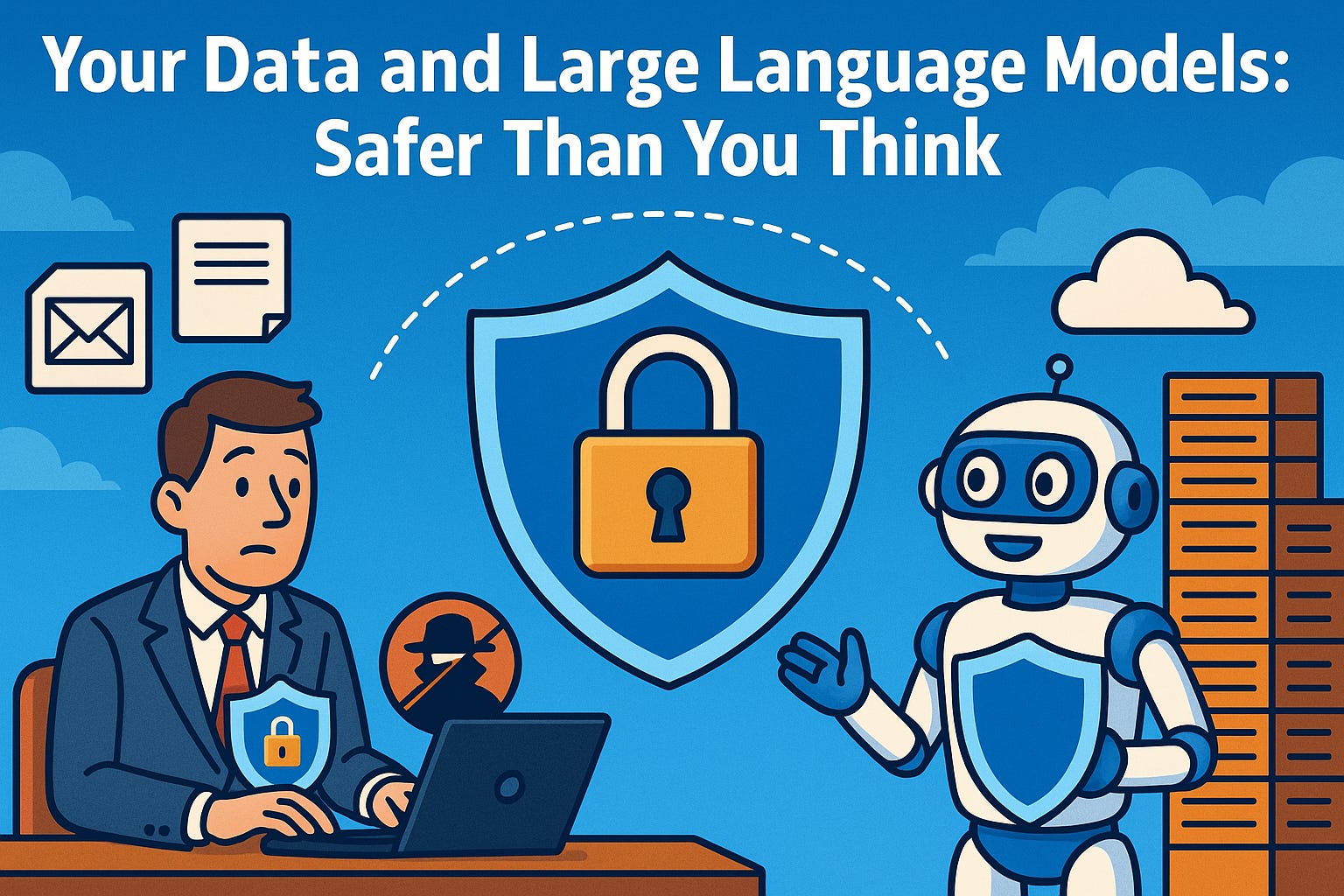
A helpful analogy is email. When you send a message, it technically passes through servers that could be accessed by authorised personnel. Yet enterprise email systems have layers of encryption, strict access controls and compliance frameworks, making them a trusted infrastructure for daily business. Using an LLM under enterprise terms is comparable. Someone could read the data in theory, but in practice, robust controls and contractual protections make that vanishingly rare.
Consider the spectrum of security tiers:
Consumer mode: Casual use where prompts may be logged for product improvement.
Enterprise mode: Data is isolated, encrypted and excluded from future training. Providers guarantee confidentiality in line with global compliance standards.
Private deployment: Some firms run their own instances of LLMs, ensuring data never leaves internal servers.
For highly sensitive sectors—finance, healthcare, and defence—companies are already adopting private or enterprise instances precisely because they meet the same security benchmarks as other critical IT systems. Morgan Stanley, PwC and the NHS are all experimenting with LLMs under enterprise-grade protections, treating them like standard business infrastructure.
Using an LLM under enterprise terms is comparable. Someone could read the data in theory, but in practice, robust controls and contractual protections make that vanishingly rare
The bottom line: using an LLM responsibly is not riskier than sending a confidential email or storing files in the cloud. With enterprise safeguards in place, the likelihood of data leakage is extraordinarily low. The real strategic risk is hesitating too long and watching competitors build efficiency gains while security concerns linger.