
iPhone 17e Intelligence
Apple’s iPhone 17e makes AI practical: faster on-device models, smarter workflows, and clearer upgrade logic for teams.

The iPhone 17e is a “budget” phone that quietly normalises on-device AI
The iPhone 17e is priced like an entry iPhone, but it behaves like an AI-first device. That matters because the real shift in 2026 is not “more AI features”. It is AI becoming an expected default in everyday comms, note-taking, image work, and small operational decisions.
Apple’s play is simple: put Apple Intelligence in more hands without forcing a Pro purchase. The 17e does that by combining the A19 chip with an AI-capable architecture (Apple highlights a 16-core Neural Engine plus Neural Accelerators tied into GPU cores), while keeping the overall product positioned as “value”. (Apple)
If you manage a business function, advise clients, or build investment theses, the 17e is useful as a signal: AI is moving from ‘pilot’ to ‘plumbing’. The practical question is no longer “should we use AI?”, but “which workflows become faster, safer, and more consistent when AI is on-device by default?”
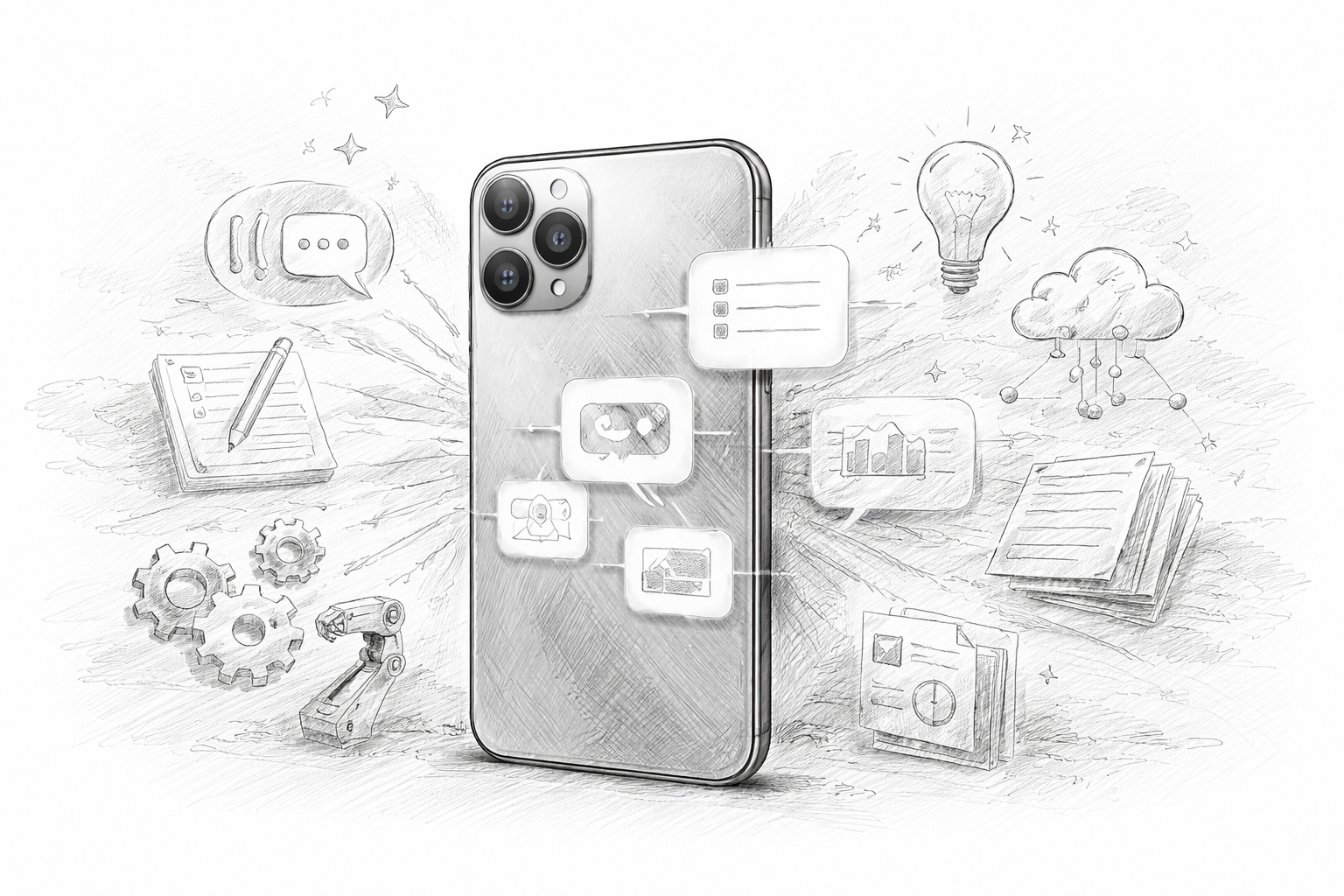
What “AI in iPhone 17e” actually means in practice
Most AI conversations still get stuck in marketing language. For the 17e, think in three layers:
1) On-device intelligence becomes the norm
Apple is explicit about compatibility: iPhone 17e supports Apple Intelligence.
In practice, “on-device” is not a philosophical preference. It changes three operational constraints:
Latency: faster small tasks (rewrite, summarise, generate) because the phone is not always waiting on the network.
Reliability: fewer “can’t connect” moments during travel, client visits, site work, or in secure buildings.
Risk surface: less data leaving the device by default, which makes internal adoption easier even before legal and IT finish the paperwork.
This is why the “entry model” status matters: if junior staff have access to the same baseline AI layer as leadership, adoption is no longer limited to a small group of power users.
2) AI becomes a workflow tool, not a novelty
The best use cases are not spectacular. They are boring, repetitive, and slightly annoying without help:
Turning messy meeting notes into a clean follow-up email
Converting voice thoughts into a structured brief
Drafting client-ready language from bullet points
Rewriting sensitive text in a neutral tone
Summarising long documents into decision points
The 17e’s value is that it makes these things “always available” on a device people already use all day.
3) Hardware choices start to look like AI governance
When Apple says the A19 is built to run Apple Intelligence faster than the previous generation, that is also a governance claim: “you can do more locally”.
That influences procurement logic. Buying a fleet of devices is now partially a decision about:
how much work stays on-device,
how much depends on third-party tools,
and how many exceptions you will need to manage.
The hidden story: the 17e makes AI a default upgrade reason
Historically, entry iPhones were sold on camera, battery, and “it’s an iPhone”. In 2026, the pitch becomes: it is the cheapest way to get Apple Intelligence with modern performance.
That matters for three reasons:
AI becomes a retention feature. If employees build habits around on-device intelligence (drafts, summaries, image cleanup, quick context), switching platforms becomes more painful.
AI becomes a training problem. Once the tool is ubiquitous, the bottleneck is no longer access. It is the quality of use: prompting habits, data hygiene, tone control, and knowing when not to use it.
AI becomes a compliance narrative. Apple’s positioning around privacy and on-device processing will be used in internal debates to justify adoption choices. Whether that is always warranted depends on the specific feature and workflow, but the procurement argument is real.
What you should do with this as a leader, adviser, or investor
Here are five “hands-on” moves that fit the reality of iPhone 17e-style AI.
1) Standardise 3–5 “micro-workflows” before you standardise tools
Most organisations start backwards: pick a platform, then hunt for use-cases.
Do it the other way round. Pick micro-workflows like:
“turn meeting notes into actions + owners”
“rewrite internal updates into client-safe language”
“summarise long PDFs into risk/opportunity bullets”
“generate first draft of a proposal section from a template”
Then test whether Apple Intelligence on iPhone 17e covers 60–70% of the need. If it does, you can reduce paid tool sprawl.
2) Write a one-page “AI etiquette” policy people will actually follow
Make it practical:
what data is never allowed,
what must be anonymised,
when output must be reviewed by a human,
how to label AI-assisted work internally.
A short policy beats a long one that nobody reads. The 17e will put AI in more hands; policies must be frictionless.
3) Treat on-device AI as “edge automation”
The most valuable AI wins happen at the edge: in the taxi, between meetings, after a call, at a conference, on a site visit.
If your workflows require opening a laptop, logging into three systems, and waiting for a VPN to connect, people won’t do it. The iPhone 17e’s AI story is about removing that friction.
4) Re-think what “good writing” means internally
Once drafting becomes cheap, editing becomes the premium skill.
Train teams to:
check for invented specifics,
keep tone consistent,
remove unnecessary adjectives,
verify numbers and dates,
and preserve accountability (“who decided what?”).
AI increases output volume; leaders must increase clarity.
5) Update your device ROI model
The 17e starts at 256GB storage and brings A19 performance at a lower price point than Pro models.
That is a procurement lever: fewer storage-related constraints, longer usable life, and better baseline performance for AI features.
If you run fleets, compare ROI as:
device cost over 36 months,
time saved per week per employee from micro-workflows,
and reduced spending on overlapping apps.
Even small time savings compound when every device has usable AI.
A realistic note: Apple Intelligence is not a free lunch
Two caution points worth stating plainly:
AI does not remove responsibility. If someone sends a client an AI-polished message with the wrong claim, the organisation owns it.
AI changes internal truthfulness. When writing becomes easy, people will produce confident text faster. That increases the need for a verification culture, especially in finance, legal, and regulated industries.
The iPhone 17e makes these issues more important, not less, because it spreads capability widely.
Why this matters beyond Apple
When AI becomes standard on the cheapest new iPhone Apple sells, competitors must respond: either by matching on-device performance or by relying on cloud AI, with different cost and privacy trade-offs.
For executives and advisers, the strategic angle is simple:
If AI is on every pocket device, process design beats tool selection.
If drafting is commoditised, judgment becomes the differentiator.
If AI is always available, speed becomes a cultural expectation (and teams will burn out unless you manage that deliberately).
That is the real “AI in iPhone 17e” story: not features, but organisational operating rhythm.